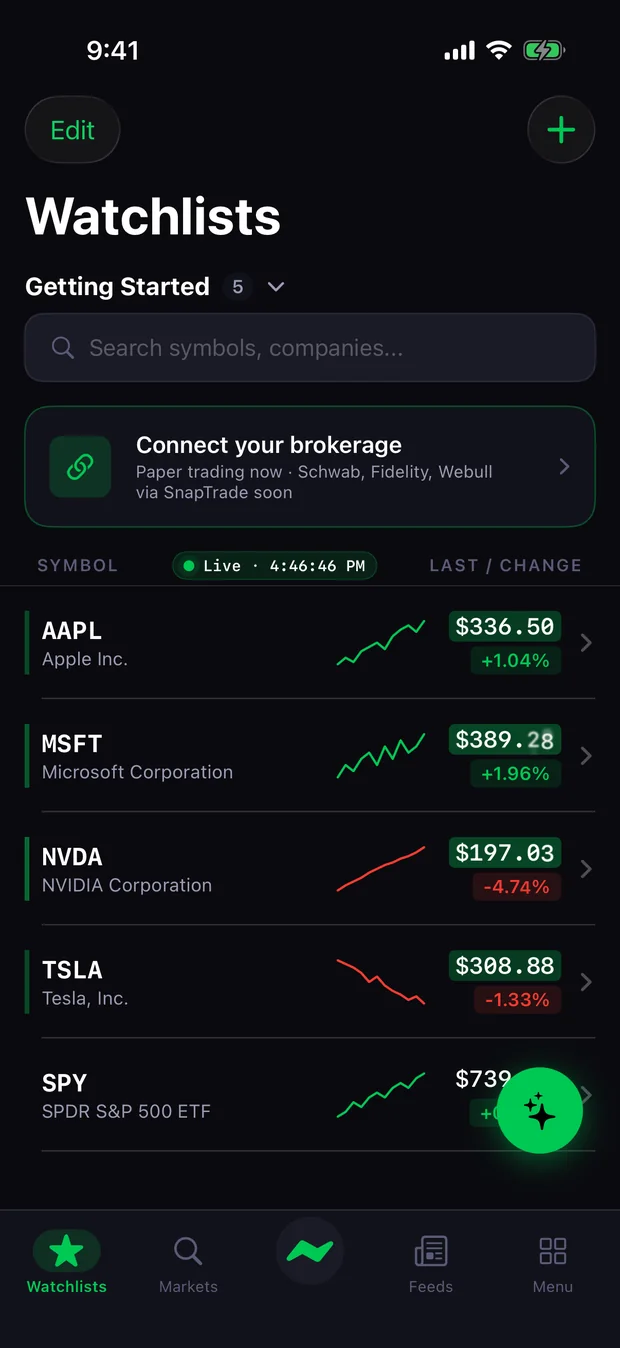
Tape is an iPhone-native execution engine for retail traders. Configure a strategy, set your risk envelope, and let Tape watch the market for you — with a kill switch always one tap away.
Tape is software, not a broker. Your funds stay with your own brokerage.
Measured in production
Independent QA pass · 27 July 2026
4.5s
Fastest fill-to-exit on a live stop-loss cross, timed during the opening hour of a real session.
92
State-changing API endpoints, every one probed anonymously. All rejected the caller, except two demo endpoints that are anonymous by design.
0 / 10
Prompt-injection attacks that got through the natural-language parser. Zero information leaked.
0
Duplicate or orphaned records found in a line-by-line reconciliation of the trade ledger across every live account.
36
Duplicate entry signals folded in a 50-minute window — no second order, no second ledger row.
92–100%
Cadence held by every isolated safety loop — stop-loss, take-profit, end-of-day — under a deliberate overload test.
Figures come from QA runs against the live production service on 27 July 2026 and describe how the system behaves — not investment performance, and not a prediction of your results. Tape publishes no trading returns, and nothing here should be read as one.
Brokers supported
Tape is software, not a broker. It never holds your money. Live orders are placed through a brokerage account held in your own name, at your own regulated brokerage.
Via SnapTrade
SnapTrade connects 20+ US brokerages. Which ones are available to you is set by SnapTrade and by each brokerage, not by Tape.
Market data & intelligence
Every price, chart and headline in Tape comes from its market-data providers. Brokerages are used for execution only.
Benzinga feeds are bundled through Massive.
Infrastructure
Fly.io — backend hosting Anthropic — AI reasoning
Tape is not affiliated with, endorsed by, or a partner of any listed provider. Naming a provider describes a service Tape uses; none of them has reviewed or approved this site, and all names and marks belong to their respective owners.
See it running
Recorded on device — no mockups, no motion graphics. This is the shipping build.
The in-app guided tour walks the full surface area — the same walkthrough every new trader sees on first launch.
How it works
Pick a strategy from the library or describe one in plain English. Set your risk envelope, universe and trading hours. Every parameter is auditable before you deploy.
Tape’s autonomous engine scans the market, surfaces candidates with plain-language rationale, and stages trades against your rules. You stay in control; Tape does the legwork.
Every trade — paper, live and backtest — lands in a single unified journal. Filter by source, review what worked, and refine.
What’s inside
Hand a strategy to Pulse. It scans, stages and executes against your rules — while you go about your day.
Tape’s backtest simulates the same decide-to-fill lag and liquidity-tiered slippage as live execution. What you backtest is what you trade.
Massive market data, Benzinga news and SEC EDGAR filings — surfaced in seconds, not minutes.
Every strategy runs rule-based with zero AI cost, or AI-assisted with Claude — same guardrails, your choice of engine.
Practice on a $100,000 paper ledger before you go live. Same engine, same execution logic, priced with real market data — and never real money.
Master switch. Per-strategy switch. One tap halts trading instantly — enforced by the execution engine, not a setting.
“Risk $100 a trade, take profit at 2%, stop at 2%.” Tape parses your intent and pre-fills the configuration.
Paper, live and backtest activity on one timeline. Filter, review, refine.
Where Tape is different
A like-for-like look at four things that decide whether a strategy survives contact with a real market.
| Typical retail trading app | Tape | |
|---|---|---|
| Execution | You place each order by hand. If you are asleep, at work, or away from the screen, the setup passes you by. | You define the rules once. The engine watches the market on your schedule and stages orders against those rules, with the reasoning shown in plain language. |
| Backtesting | Usually absent, or an idealised curve that fills instantly at the closing price and ignores spread and size. | The same decide-to-fill lag and liquidity-tiered slippage the live path uses, with gross and net shown separately so the cost of trading is visible. |
| Cost transparency | “Commission-free,” with the real cost buried in the spread, in order routing, or in a rate you never see quoted. | One flat subscription. Tape takes no cut of your trades and earns nothing from how your orders are routed. Your brokerage’s own costs remain between you and them. |
| Kill switches | You cancel orders one at a time, and close positions one at a time, while the market keeps moving. | A per-strategy switch and an account-wide switch, both enforced inside the execution engine — every order path checks them, so a halt is a halt. |
“Typical retail trading app” describes common patterns across the category in general terms. It is not a comparison against any specific named product, and it is not a claim that Tape produces better trading outcomes.
Inside the app
120+ strategies, each configurable and runnable on a symbol or a universe scan.
Live signals, fills, P&L and engine telemetry on one screen — with KILL always in reach.
Screener, calendar, backtests and session awareness — the research surface around the engine.
Built-in protections
Autonomous trading only makes sense if you can stop it. Tape’s safety systems aren’t advisory notices — they’re enforced by the execution engine itself. If the AI misfires, the guardrails hold.
One tap halts trading — account-wide for you, network-wide for operators. Verified in both directions.
Every autonomous position closes by market close. No overnight surprises unless you explicitly opt in.
A hard daily spend cap on AI calls, enforced in code and failing closed. You’ll never wake up to a runaway bill.
Every guardrail — risk per trade, take profit, stop loss, universe — is visible and editable before you run a strategy. No black box.
Shipped this week
No roadmap items. Everything below is live in the build testers are running today.
Tape now runs its own $100,000 practice ledger. You can sign up, configure a strategy and watch it trade against real market prices before you connect a broker at all — and every practice account is segregated, so one account’s activity can never touch another’s.
The account-level halt used to be advisory in places. It is now checked inside the execution engine itself, so every route that could place an order has to pass it — verified in both directions, halted and released.
One governor covers every AI call site in the product. When the daily ceiling is reached, calls are refused with an explicit budget error rather than silently degrading — and the spend ledger survives service restarts.
Realised profit and loss is now computed from the price actually achieved on the fill rather than the quote at the moment of the decision, and each order writes exactly one journal entry. Historical rows were recomputed and every live account was reconciled line by line.
We deliberately ran the live service to the point of failure to find where it breaks. It broke at the database connection pool, exactly as the logs said — so the pool was resized against a measured ceiling and the slowest endpoint went from roughly fifteen seconds to under a third of a second. More headroom work is queued.
Pricing
No trial timers. No hidden fees. Cancel anytime.
Everything you need to learn the market and the app.
Everything in Free, plus the autonomous engine.
Tape doesn’t take a cut of your trades. Your brokerage handles execution and holds your funds. Tape is a $20/month subscription — nothing more.
Questions
Straight answers, including the uncomfortable ones.
Yes. Once you connect a live brokerage account and let a strategy trade in it, real money is at risk and you can lose some or all of it. If your brokerage account permits margin or short selling, you can lose more than you put in.
Tape does not guarantee, project or protect any outcome, and it does not reduce the risk inherent in trading. Practice trading is different: it is a simulation inside Tape, no order ever reaches a broker, and no money is at stake.
Every strategy runs in one of two engines. Rule-based strategies use no AI at all — they evaluate the conditions you configured and nothing else. AI-assisted strategies additionally send the market context and your configured rules to a Claude model, which returns a directional read — bullish, bearish or neutral — together with a written rationale.
The model does not invent rules, set your position size, or change your risk settings. Risk per trade, take profit, stop loss, universe and trading hours are yours, and they are enforced in code after the model answers. Every candidate carries its rationale into the journal, so you can read why a trade was taken after the fact.
Tape has no “crash mode” and makes no claim to protect you from a falling market. What it does have is mechanical: stop losses are evaluated continuously against live prices, autonomous positions are closed by the end-of-day sweep at the close unless you have explicitly opted out, and both kill switches remain available throughout.
You should assume that in a fast, gapping or illiquid market a stop can fill well below its trigger price, or fail to fill at all. That is a property of markets, not something software removes.
Always. You can pause or stop an individual strategy, halt everything in your account with the master switch, or close any position yourself. These are not advisory flags: the checks live inside the execution engine, so every path that could place an order has to pass them first.
A halt takes effect on the next evaluation and prevents new orders. It does not retroactively unwind an order that has already been sent to a venue.
Practice trading needs no broker at all — you can sign up and run strategies against real market prices on a simulated ledger straight away.
For live trading, Tape connects to Alpaca directly, and to Robinhood, Fidelity, Charles Schwab, Webull, E*TRADE, Interactive Brokers, Tradier, Public and more through SnapTrade. Tape is not a broker itself. When you connect a brokerage, your funds stay in your own account, in your own name, at your own SEC- and FINRA-regulated brokerage. Tape never takes custody of them and never opens an account on your behalf.
There is a free tier at $0 and a Pro tier at $20 a month. That subscription is the whole of what Tape charges: no cut of your trades, no per-trade fee, and no revenue from how your orders are routed.
Your brokerage’s own costs — spreads, commissions, fees, margin interest — are set by your brokerage and remain between you and them. You can cancel at any time.
To run the product, Tape stores your account details, the strategies you configure, and the record of the orders and journal entries they produce. When you connect a brokerage through SnapTrade, Tape receives the access needed to read your positions and place the orders you have authorised — your brokerage login credentials are handled by that connection flow and are never entered into or stored by Tape.
Market data, news and filings come from third-party providers listed above. A full privacy policy is in preparation; until it is published, treat this answer as a plain description of how the product works rather than a legal commitment.
No. Tape is software. It is not a broker-dealer, not an investment adviser, and not registered with the SEC or FINRA in any capacity. It does not hold your money, take custody of assets, recommend securities, or provide personalised investment advice.
Practice trading is a simulation Tape runs. Live trading is executed by your own regulated brokerage, on instructions generated by the rules you configured.
Get Tape
Tape is not on the App Store yet. Beta builds go out through TestFlight, by invitation.
Send us a note and we’ll add you to the tester list and reply with a TestFlight link. You’ll need an iPhone and a few minutes to set up a practice account.
Scan to request access Opens a pre-addressed email to hello@tapetrading.co on your phone. No app or account needed to scan it.
Requires iPhone and iOS 17 or later. Invitations are issued manually, so allow a little time for a reply.
One short email when the beta opens up, and occasional notes on what shipped. No trading tips, no signals, no reselling your address.
Joining the list is not an application for a brokerage account and does not give Tape access to any account of yours.
Who’s building this
Tape started from a straightforward observation: the tooling that lets an institution run a strategy continuously — scanning, staging, exiting, and keeping an auditable record of all of it — has never really existed for an individual trader on a phone. Retail platforms optimise for placing an order. Almost none of them optimise for running a strategy.
So the priorities have been the unglamorous ones: an execution path you can stop, a ledger that reconciles, backtests that model the costs a real fill incurs, and a spend ceiling that fails closed. Those are the things that are painful to retrofit, and they are what the weekly notes above keep coming back to.
[PLACEHOLDER: Andrew’s personal note]
[PLACEHOLDER: founder name, role, background, photo]
Tape never holds your money and never trades on its own account. Paper Trading is a simulation run by Tape — orders are priced with real market data, but are never sent to a broker and never involve real money.
Live brokerage connections run through Alpaca directly and through SnapTrade for other brokerages. When you connect one, trades route through your own SEC- and FINRA-regulated brokerage, and you keep full control of your funds and every trade.
Tape is in beta on iPhone. Request an invite and we’ll get you set up.
Requires iPhone. Trading involves risk of loss.