Features
Everything you need to run a strategy. Nothing you don’t.
Three steps from idea to execution, the eight things the engine gives you, and a like-for-like look at where Tape differs from a typical retail trading app.
Join the waitlistHow it works
Three steps from idea to execution.
Configure
Pick a strategy from the library or describe one in plain English. Set your risk envelope, universe and trading hours. Every parameter is auditable before you deploy.
Execute
Tape’s autonomous engine scans the market, surfaces candidates with plain-language rationale, and stages trades against your rules. You stay in control; Tape does the legwork.
Review
Every trade — paper, live and backtest — lands in a single unified journal. Filter by source, review what worked, and refine.
Autonomous execution
Hand a strategy to Pulse. It scans, stages and executes against your rules — while you go about your day.
Backtests that match live execution
Tape’s backtest simulates the same decide-to-fill lag and liquidity-tiered slippage as live execution. What you backtest is what you trade.
Real-time market data
Massive market data, Benzinga news and SEC EDGAR filings — surfaced in seconds, not minutes.
AI-assisted strategies
Every strategy runs rule-based with zero AI cost, or AI-assisted with Claude — same guardrails, your choice of engine.
Paper Trading
Practice on a $100,000 paper ledger before you go live. Same engine, same execution logic, priced with real market data — and never real money.
Kill switches
Master switch. Per-strategy switch. One tap halts trading instantly — enforced by the execution engine, not a setting.
Natural-language strategy builder
“Risk $100 a trade, take profit at 2%, stop at 2%.” Tape parses your intent and pre-fills the configuration.
Unified journal
Paper, live and backtest activity on one timeline. Filter, review, refine.
Inside the app
Built for the way traders actually work.
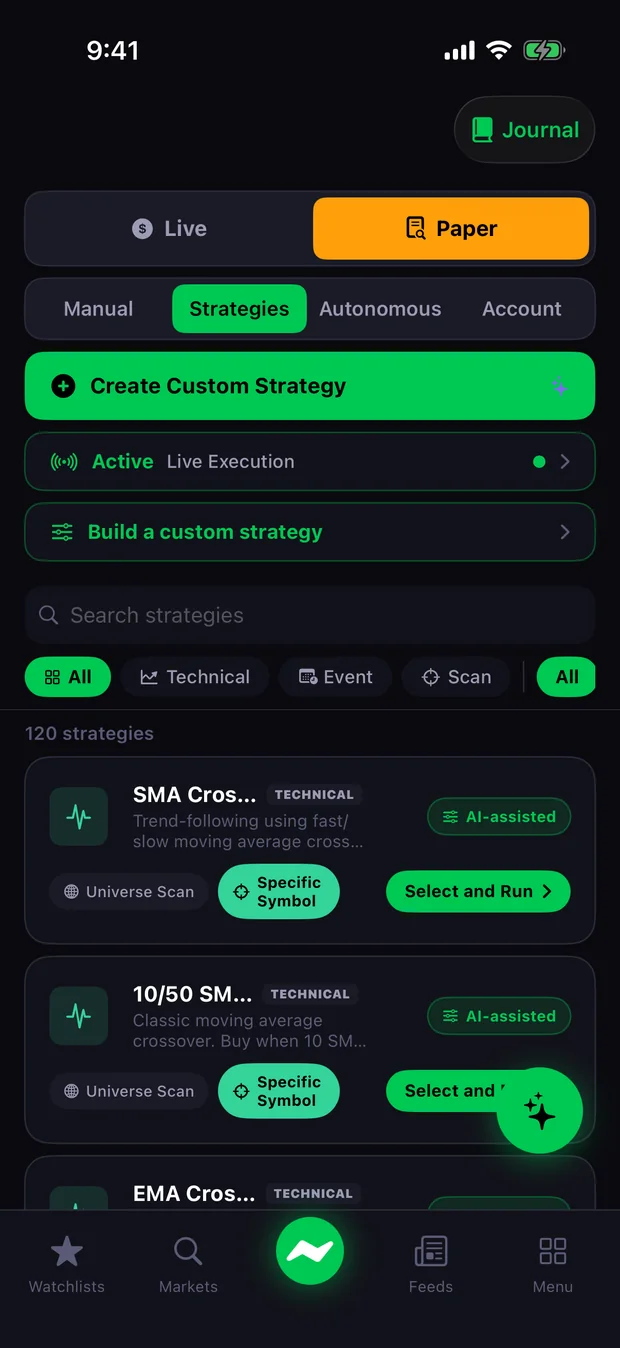
Strategy library
120+ strategies, each configurable and runnable on a symbol or a universe scan.
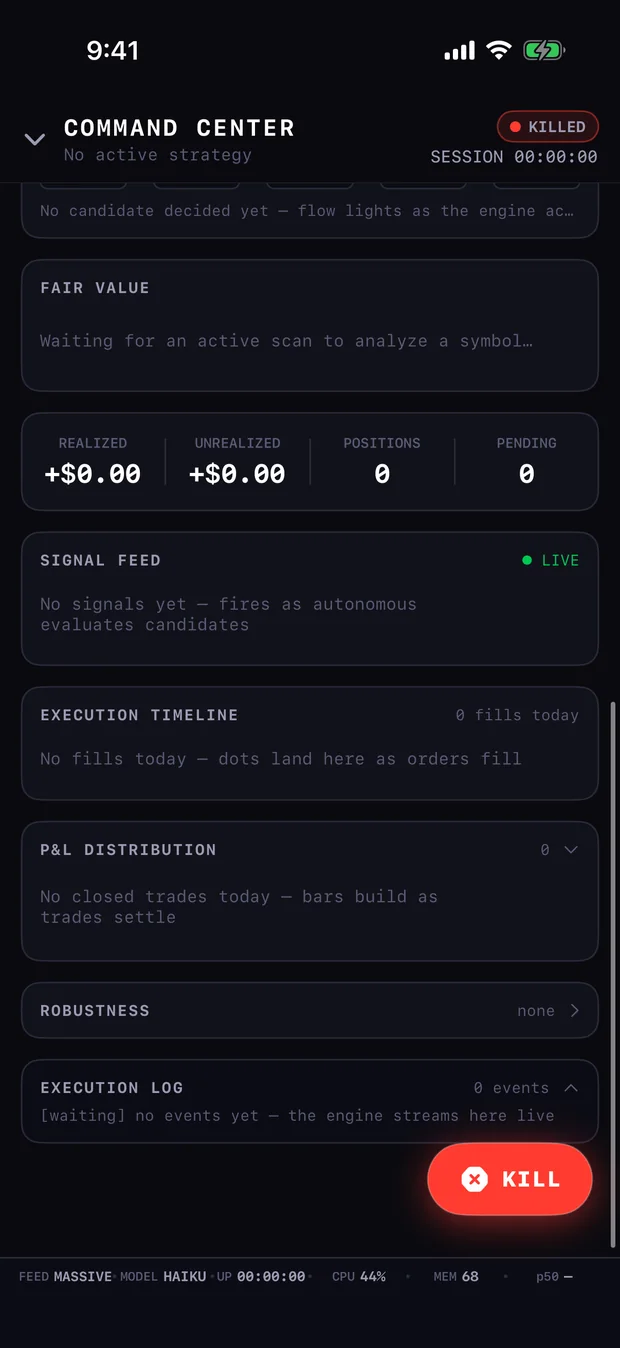
Command Center
Live signals, fills, P&L and engine telemetry on one screen — with KILL always in reach.
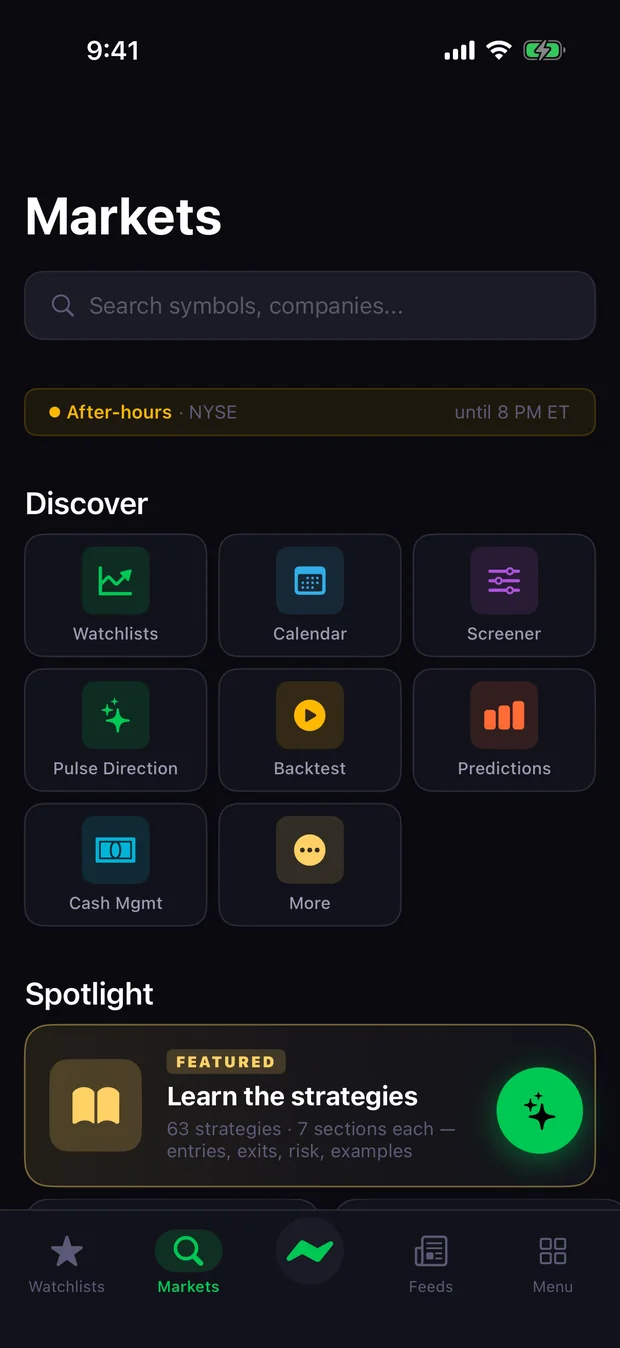
Markets
Screener, calendar, backtests and session awareness — the research surface around the engine.
Where Tape is different
Most trading apps hand you a button. Tape hands you an engine.
A like-for-like look at four things that decide whether a strategy survives contact with a real market.
| Typical retail trading app | Tape | |
|---|---|---|
| Execution | You place each order by hand. If you are asleep, at work, or away from the screen, the setup passes you by. | You define the rules once. The engine watches the market on your schedule and stages orders against those rules, with the reasoning shown in plain language. |
| Backtesting | Usually absent, or an idealised curve that fills instantly at the closing price and ignores spread and size. | The same decide-to-fill lag and liquidity-tiered slippage the live path uses, with gross and net shown separately so the cost of trading is visible. |
| Cost transparency | “Commission-free,” with the real cost buried in the spread, in order routing, or in a rate you never see quoted. | One flat subscription. Tape takes no cut of your trades and earns nothing from how your orders are routed. Your brokerage’s own costs remain between you and them. |
| Kill switches | You cancel orders one at a time, and close positions one at a time, while the market keeps moving. | A per-strategy switch and an account-wide switch, both enforced inside the execution engine — every order path checks them, so a halt is a halt. |
“Typical retail trading app” describes common patterns across the category in general terms. It is not a comparison against any specific named product, and it is not a claim that Tape produces better trading outcomes.
Put your strategy to work.
Tape is coming to the app stores soon. Join the waitlist to be the first to know.
Trading involves risk of loss.